
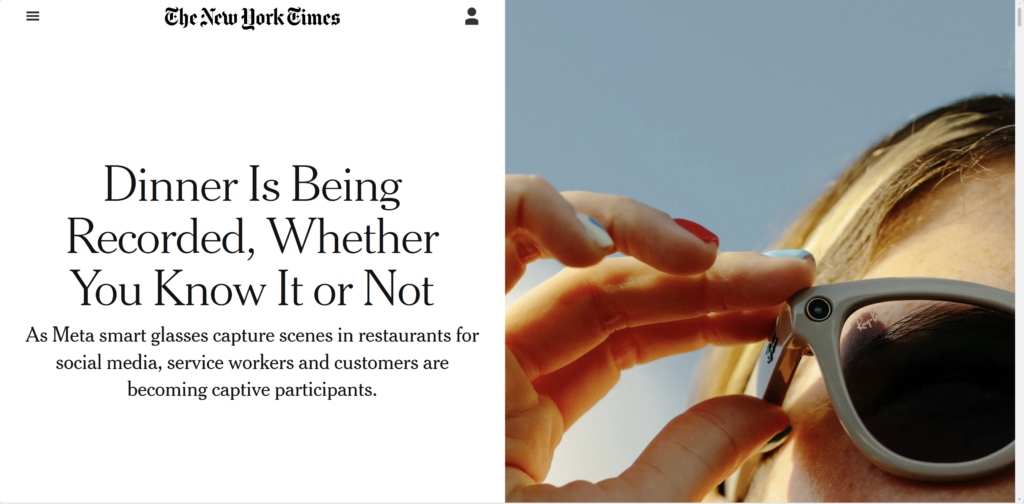
We were quoted in the The New York Times yesterday in an article entitled “Dinner Is Being Recorded, Whether You Know It or Not,” which revolved around privacy concerns while dining out in the face of consumer tech like Meta Ray-Ban glasses — which enable innocuous recording — beginning to proliferate. The quote blurb:
Some states, including California and Pennsylvania, have two-party consent laws that prohibit recording without express permission, but enforcing them hinges on whether someone has a “reasonable expectation of privacy” in a given setting, said Aaron Krowne, a New York City lawyer specializing in privacy and civil liberties. Restaurants fall in a legal gray area: They are privately owned, but open to anyone who walks in. Those protections haven’t been tested in cases involving smart glasses. “It has managed to stay out of the courts, which is quite shocking,” Mr. Krowne said. “I’m sure we’ll see more lawsuits soon.
I wanted to elaborate here a bit more on the legal points afoot (which I did touch on in conversation with the article’s author, but there’s only so much space in these articles, and they try not to get too technical).
For one, not mentioned in the article is a specific case that motivated my above comment: the current case of Project Veritas v. Schmidt, 125 F.4th 929 (9th Cir. 2025), in which the 9th circuit overruled Oregon’s two-party consent law as applied to public places, holding it contrary to the First Amendment. Now, the case is being petitioned to the Supreme Court, and whether it takes the case up or rejects certiorari, it will be a significant result for the law of surreptitious public recording (i.e., either a circuit split will be created which balkanizes the enforceability of state two-party consent laws over first amendment concerns around the country, or the Supreme Court will create a national-level rule).
At first blush, the same kind of legal conflict doesn’t seem to exist for one-party consent laws (i.e., that only one party to a conversation is needed to consent to allow its recording — applicable in states like New York.) Being more permissive, as far as both the recording action itself, and first amendment rights, doesn’t seem like a problem. However, intuition tells us that one-party consent rules cannot possibly allow recording in truly private situations. And indeed, there’s no argument that such laws could, for instance, override any of the four common law “privacy causes of action”: (1) appropriation of name or likeness for trade purposes; (2) publication of private facts; (3) false light; or (4) intrusion upon solitude.
Importantly, the social media posting aspect of today’s commonplace reality of using such consumer tech renders all the underlying rights concerns more acute (this connects back to, and heightens the “publication” aspect of the above privacy torts — though intrusion upon solitude doesn’t strictly require publication).
At the end of the day, recording consent laws should not be seen as enabling laws — they instead create a free-standing prospective statutory violation, and are otherwise cabined on one side by the first amendment, and on the other by privacy law (which is mainly common law, lacking as clear a constitutional basis as free speech). It’s these fundamental rights that are the main legal drivers of legal outcomes in this space, and balancing these rights is now having to be revisited as the proliferation of innocuous recording eyewear (with prospective social media posting) scrambles social practices and expectations.